
Updated 19 November 2026
How to Win Aviator: Staking Costs from a R10 Example
A staking system changes your spending, while every accepted bet still faces a random crash.
You win an Aviator bet only when cash-out is accepted before the plane crashes. A staking system cannot ensure that happens. Take a R10 example: the full R10 goes if the flight ends first, whatever the system is called. Your plan can limit spending; the next flight stays random.
Increasing stakes changes the exposure
A progression raises or lowers the next stake after a result. The name describes how you spend, rather than how the plane will fly. A further stake can still be lost in full.
| Staking approach | How the next stake is chosen | What increases the exposure |
|---|---|---|
| Fixed stake | Repeat the starting stake | Each failed round adds another fixed loss |
| Martingale | Multiply the previous losing stake by two | Several failures can demand a much larger next bet |
| Fibonacci | After losing, advance through the number sequence | Later entries can require a larger balance |
| D’Alembert | Move up one unit on a loss, down one following a win | A losing sequence raises the amount exposed |
| Paroli | Increase the amount following successful bets | The next failed exit can consume earlier gains |
| Labouchère | Add the first and last numbers of the written sequence | A loss adds to the sequence and can raise the next entry price |
A doubling sequence in rand
Martingale can become costly quickly. Beginning at R10, the example loses R70 in the first three bets, then calls for R80 on the next one. That stake is bigger than the losses already incurred. By this point your budget has shrunk, yet following the recovery plan requires risking more than the original loss; stopping the sequence may be the only way to stay within the amount you intended to spend.
| Illustrative failed round | Loss on that entry | Cumulative cost |
|---|---|---|
| First entry | R10 | R10 |
| Next bet | R20 | R30 |
| Following bet | R40 | R70 |
The familiar doubling calculation relies on a paid 2.00× exit, returning twice the stake with the stake included. A lower target changes the recovery sum. If the crash comes first you lose the bet, while the bookmaker’s maximum stake may prevent the next increase.
Price a run with a flat stake
Keeping the stake fixed makes losses straightforward to count. Increasing it after a loss puts more money on the next random flight. Betting closes before take-off, so past results offer no advance view of the coming crash.
Compare the spending rules using the calculations below. Every amount is illustrative; none is a recommended stake or bookmaker limit.
The long-run cost of turnover
At Spribe’s printed 97% return to player, a R100 arithmetic example has R3 expected loss, regardless of the staking system. Progressions alter how much you spend and how results spread out. See crash probabilities for the probability model supporting this calculation.
Exit settings cannot remove losses
Auto cash-out sets a target; the plane can still leave before reaching even a low one. “Auto Play” keeps placing the chosen stake. Set the Auto Play stop rules before starting, because repetition can carry a losing run on without a pause.
- Increasing stakes makes each further loss more expensive.
- Cash-out settles the round in your balance; withdrawing to a bank follows separate bookmaker terms.
A fixed stake beside a history sample
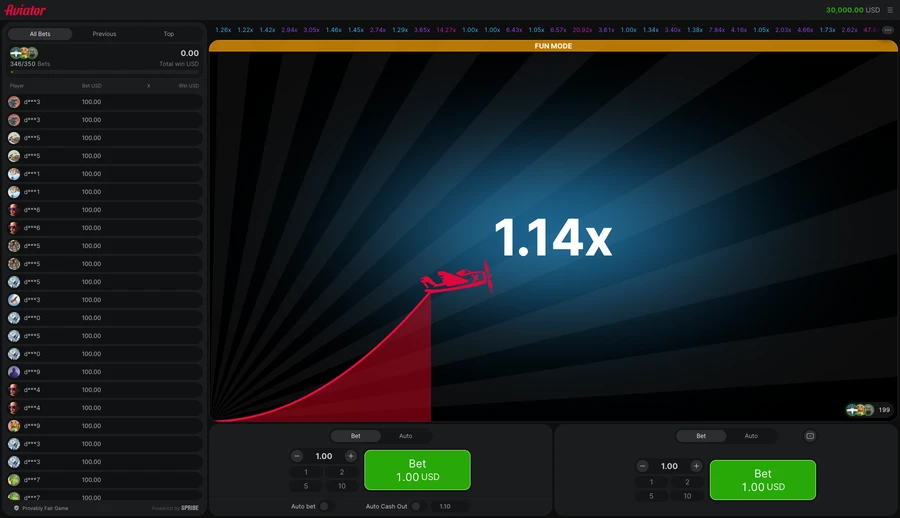
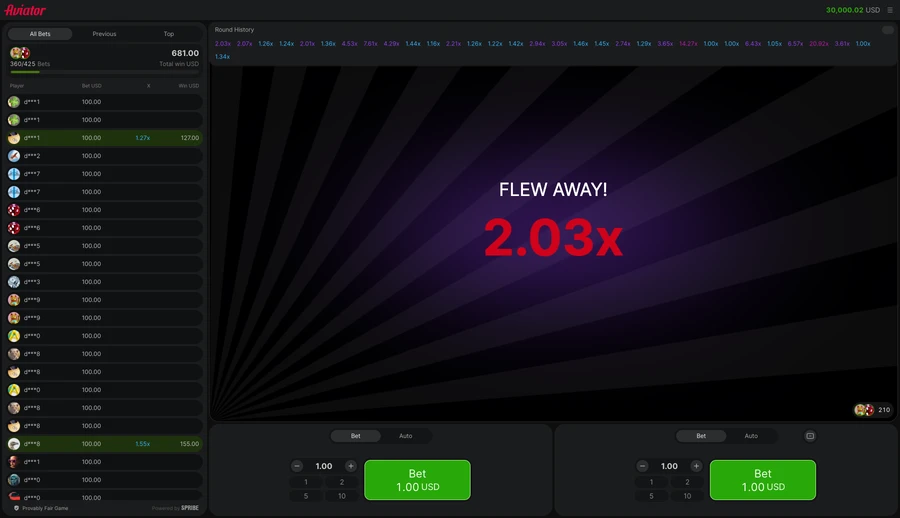
Method: the official Spribe demo was captured on 20 November 2026; the newly placed bet, displayed history and revealed round inputs were recorded separately.
| Recorded item | Value | Meaning |
|---|---|---|
| New session | One bet at USD 1.00 | USD 1.02 returned |
| Below 2.00× | 14 of 30 | Completed flights in the separate history sample |
| Above 10.00× | 2 of 30 | Past flights, separate from the stake ledger |
The history sample and the personal ledger measure different activity. Neither is large enough to establish a staking advantage.
A spending ceiling comes first
Avoid loss-chasing progressions if you want a fixed spending limit: a later stake can exceed what you planned. Set a loss budget from money available for leisure before playing. Check the logged-in panel’s rand limits, keep stakes fixed after losses, then stop at the boundary you chose. If sticking to that limit becomes difficult, leave the game and use the support tools.
Paying for tips adds an expense without removing uncertainty from a round. Read why predictors fail before spending money on a forecast.
Player rating
Comments
Create a site account or sign in to comment.
Frequently asked questions
What makes an Aviator bet win?
Cash-out must be accepted before the crash. No system ensures profit. At the printed 97% RTP, a R100 arithmetic example carries R3 expected loss.
Can a staking progression beat Aviator?
No, changing the stake leaves the next outcome random. You can still lose the whole bet.
Will Martingale recover all losses?
No, further losses require larger stakes. Your budget or the bookmaker’s stake limit can end the sequence before a bet pays.
Does an early automatic exit ensure a payout?
No, the crash can come first. The documented rule also treats an exact match between crash and automatic target as a loss.
Does 97% RTP promise a session return?
No, Spribe’s published percentage is theoretical. Read your bookmaker’s applicable rules; the return in a short session can differ widely from a long-run average.
What evidence supports the staking examples?
The examples are calculations using documented game rules. They illustrate spending rather than reporting results from a played session.
18+ only · Set limits
Gambling involves risk. Gambling is not an investment.
Set a time limit with a loss budget. Take breaks and leave essential money aside. Read about limits and support.
No published comments yet. Describe your experience of the game.