
Aviator Odds: 97% RTP and R3 Expected Loss per R100
See what the probability model calculates, with rand examples and its limits alongside the figures.
At a 2.00× target, the simplified model gives a 48.5% reach probability when calculated from the studio’s stated 97% RTP. A larger target offers more when it pays, but fewer flights reach it. These calculations depend on the stated model. The next crash remains a fresh result, with its displayed value subject to the exact-tie rule.
Targets trade frequency for payout
Set r = 0.97 for this model, with M as the chosen target. Apply P(reaching M) ≈ r / M to obtain the table’s probabilities. The odds records use that expression for each target. RTP alone cannot specify the exact distribution, so the figures model outcomes rather than report new tests across live games.
| Target M | Simplified calculation | Modelled probability of reaching the target |
|---|---|---|
| 2.00× | 0.97 / 2 | 48.5% |
| 5.00× | 0.97 / 5 | 19.4% |
| 10.00× | 0.97 / 10 | 9.7% |
| 100.00× | 0.97 / 100 | 0.97% |
Choose a higher target and, under the model, you accept more failed attempts in exchange for a larger paid return. History looks backwards. Earlier multipliers leave the next flight’s chance unchanged; the provably fair check verifies results after they happen. For automatic exits, a crash exactly on the chosen value loses. Read the round rules for that boundary and settlement details.
Elapsed time versus an outcome
The multiplier begins at 1.00×. The dated client formula below describes its rise, using ms for milliseconds and floor for rounding down to a whole number at that step. The curve measures growth while the plane is flying; a crash can stop it at any point.
| Formula stated by the client | Meaning |
|---|---|
floor(100 * exp(0.000083 * ms)) / 100 | An exponential value with hundredth-level rounding down |
Higher values require longer flights. The growth expression gives you no end time or final multiplier, even after you have watched the plane for a few seconds. A slow start can still stop immediately. Read this as a dated rule for an ongoing flight’s growth, apart from any advance knowledge of the random ending.
| Seconds since take-off | Multiplier calculated while the round continues |
|---|---|
| 1 second | 1.08× |
| 5 seconds | 1.51× |
| 10 seconds | 2.29× |
| 30 seconds | 12.06× |
Expected cost in rand
At the printed RTP, the R100 arithmetic example has R97 expected gross return with R3 expected loss, a long-run figure based on total stakes rather than your deposit because money can be paid back and bet again, making turnover higher than the sum you first put in. A brief run can diverge widely from that theoretical percentage.
| Illustrative R10 stake | Return if the exit succeeds | Model chance | Modelled average returned amount |
|---|---|---|---|
| Exit at 2.00× | R20 | 48.5% | R9.70 |
| Exit at 10.00× | R100 | 9.7% | R9.70 |
Multiply payout by probability in this model and the target cancels out. Subtract the stake to get R0.30 expected net loss for either example. Earlier exits change the frequency of payouts, leaving the modelled return rate intact. These sums assume the stated RTP, an accepted cash-out and no effect from a payout cap.
RTP appears in the game text through a configured value. The rate used in these examples comes from Spribe’s game page. Before using it to calculate a paid rand bet, check the rules in your logged-in South African game.
A flight can stop immediately
A crash at the start can take the bet before your exit target is reached.
A simplified model can assign the missing 3% to an opening crash. That leaves out rounding, which can group other very short flights under the same displayed label. You therefore need actual results to measure the label’s frequency in history; the house edge on its own cannot supply that count.
Sample frequency beside theoretical return
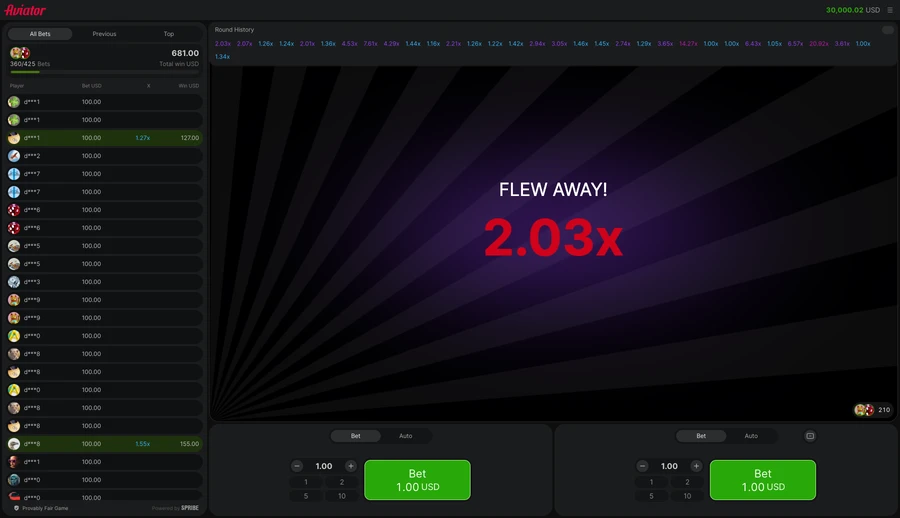
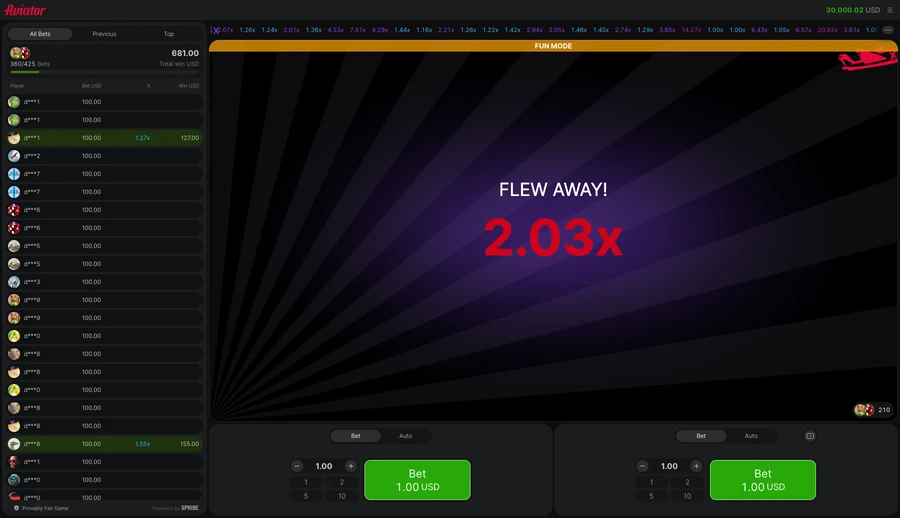
Method: the official Spribe demo was captured on 20 November 2026; the newly placed bet, displayed history and revealed round inputs were recorded separately.
| Recorded item | Value | Meaning |
|---|---|---|
| Below 2.00× | 14 / 30 | 46.67% of this sample |
| Above 10.00× | 2 / 30 | 6.67% of this sample |
| Exactly 1.00× | 2 / 30 | 6.67% of this sample |
Observed frequencies in a small snapshot can differ from a long-run probability. Treating this list as the odds for the next bet confuses a past count with a theoretical model.
Automation leaves the edge in place
Giorgi Tsutskiridze’s 21 October 2026 iGaming.News interview states that adding a second bet or an automatic exit does not alter the game’s mathematics. Splitting stakes or changing targets affects the hit rate rather than the model’s return. Compare the additional spending under staking systems.
- Under this model, fewer flights reach the higher targets.
- Repeated small stakes still add up to more money exposed.
- A run of early crashes leaves the next flight owing you nothing.
Paid play is for adults. Decide the loss limit beforehand, then leave it in place: raising the next stake to chase a loss puts more money at risk.
Player rating
Comments
Create a site account or sign in to comment.
Frequently asked questions
What chance does the model give for 2.00×?
At the printed 97% return, the illustrative calculation gives 48.5%. That conditional figure is neither a measured frequency nor an exact paid-exit probability.
Will a higher target raise the expected return?
No, the model offsets the larger return with a lower chance of reaching it. Consider payout caps and settlement boundaries separately.
Can the growth formula tell you when the crash comes?
No, the expression describes the multiplier during a live flight. A new random outcome sets the point at which the plane leaves.
Does an exact tie at an automatic target win?
No, the official client treats the tie as a loss. Read the ending label as the boundary following the last reached step.
How were the probability tables calculated?
The tables use the printed RTP, the captured growth expression and an explicit survival model. Their frequencies are calculations rather than a new played sample.
18+ only · Set limits
Gambling involves risk. Gambling is not an investment.
Set a time limit with a loss budget. Take breaks and leave essential money aside. Read about limits and support.
No published comments yet. Describe your experience of the game.